
Care Through Understanding
Improving Dental Care for People With Dementia Starts With Understanding Caregivers
Hunt School of Dental Medicine study will examine how caregivers’ oral health literacy may influence dental care for people with dementia—and caregivers themselves
A new study led by researchers at Texas Tech Health El Paso’s Hunt School of Dental Medicine will examine how the oral health knowledge of informal caregivers—unpaid family members or friends who help care for someone with dementia—may influence access to dental care for both the person receiving care and the caregiver.
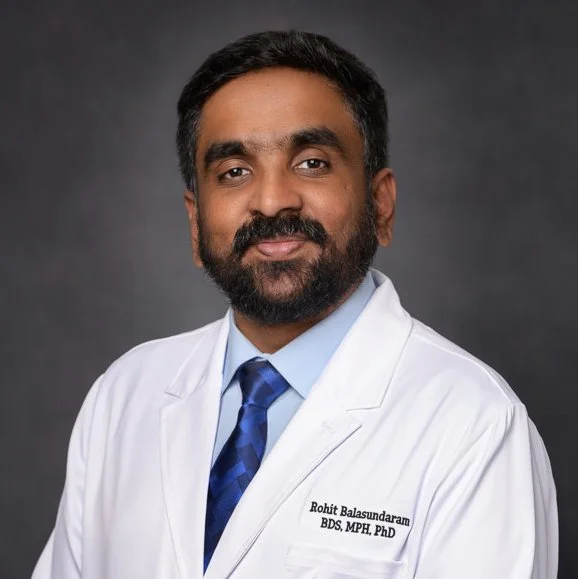
The research, led by Rohit Balasundaram, B.D.S., M.P.H., Ph.D., assistant professor at the Hunt School of Dental Medicine, has received support from the American Association of Public Health Dentistry Foundation’s Small Grants Program. The program provides one-year grants of up to $5,000 to innovative dental public health research and education projects, with the goal of generating preliminary data that can help researchers pursue larger grants and advance science, policy and practice. The research team has received $5,000 through the program, with an additional $5,000 in funding pending.
“Older adults living with dementia or Alzheimer’s disease often depend on caregivers to make dental appointments, provide transportation, schedule follow-up visits and help them navigate the dental care system,” Dr. Balasundaram said.
Those responsibilities can make caregivers an important link between people with dementia and the oral healthcare they need. Yet researchers say relatively little is known about how caregivers’ oral health literacy—their knowledge and understanding of oral health—affects decisions about seeking dental care. Caregivers may also put their own dental needs aside as they manage the medical and everyday needs of someone else.
“These challenges can be particularly pronounced in underserved and rural communities, where dental providers experienced in caring for patients with dementia may be limited,” said Salma Elwazeer, B.D.S., M.D.S., M.P.H., assistant professor and director of Interprofessional Education and Public Health Education at the Hunt School of Dental Medicine. “The issue is especially relevant in the El Paso region, where the research team is addressing the needs of a large Hispanic population and the growing number of older adults at risk for dementia.”
The research team also includes Faeq Quadri, B.D.S., M.S., Ph.D., assistant professor and director of Dental Research at the Hunt School of Dental Medicine.
Researchers plan to recruit up to 240 informal caregivers of adults with dementia. Participants will complete a survey examining oral health literacy, dental visits and factors such as family support and transportation challenges. Recruitment materials and the survey will be available in English and Spanish.
A smaller group will participate in in-depth interviews exploring how caregivers make dental care decisions, including the effects of insurance, cost, transportation and scheduling, as well as the challenges they face in maintaining their own oral health.
The researchers ultimately hope to identify barriers that can be addressed through education, improved services and other interventions. Findings will also provide preliminary data for future studies and applications for larger external grants.
For Balasundaram and his colleagues, the study represents an opportunity to better understand an often-overlooked part of dementia care—and potentially improve oral health for both people with dementia and the people who care for them.